
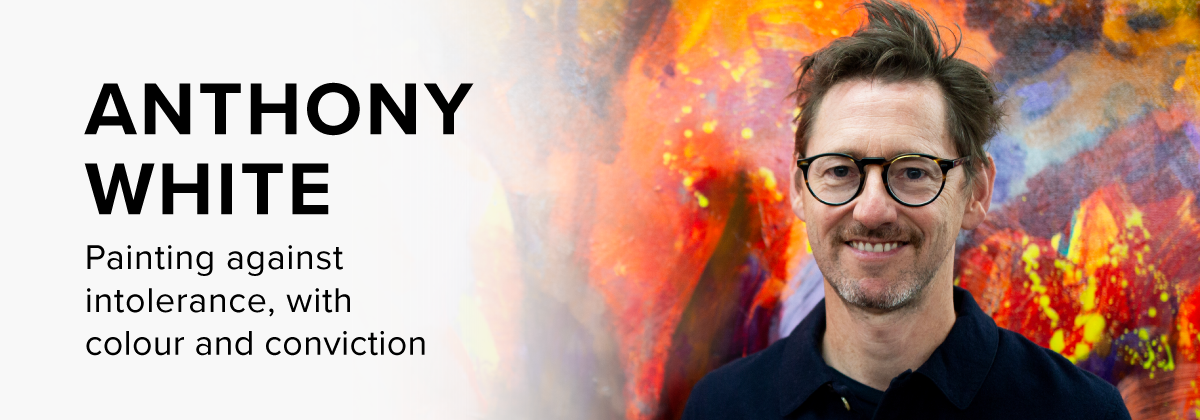
Artist spotlight: Anthony White – Painting against intolerance, with colour and conviction
February 26, 2026
Anthony White’s paintings don’t whisper. They stride into the room – bold, colour-charged, and alive with the push-pull of light and dark. An Australian artist who has been based in Paris for sixteen years, White describes the city as a place where sheer exposure to art keeps you moving forward: “you can’t help but be challenged about what you’re thinking about.” Paris was not a strategic brand move as much as an energetic leap. Asked why he relocated, he laughs: “Why not? Basically… why not?” before recalling a formative residency at La Cité Internationale des Arts in 2009 that convinced him to stay.
A practice driven by intent and energy
White talks about his artistic evolution less as a tidy style shift and more as a long, ongoing clarification of purpose. “You gotta ask yourself questions why you’re doing what you’re doing… what is it that you want to say?” he explains, adding that it takes time to discover that clarity. That self-interrogation anchors his process. Earlier in his career he painted in a gestural, body-led way; today he often begins with photographic reference, but he’s adamant that technique must serve something deeper. “The energy in a painting is really important,” he says, because it comes from “the desire of the making of the painting in the first place… that original intent is really important.”
Bold colour, experimental making
The works White has shared through the Visual Arts Image Bank are strikingly optimistic—bright, assertive, and unafraid of beauty. He calls them “very bold… optimistic because of their use of colour,” linking that brightness to a belief in tolerance. That understanding of colour sits within a longer lineage of artists who viewed abstraction as inseparable from life and politics. In 2017 White undertook a residency at the Mark Rothko Centre in Latvia, researching Rothko’s work and the thinking of his teacher Josef Albers. As Albers put it, “colour is relative, volatile and political,” adding that even the most abstract-looking art, “if your eyes are open to it, has everything to do with life.” This idea reinforces why colour in White’s work is never neutral – it carries emotional, ethical and social weight.
Art as dissent in an age of intolerance
Under the colour sits a fierce political conscience. White says this body of work emerged from his reaction to the present moment: a “rising sense of intolerance… in society and… the rise of fascism.” He’s especially disturbed by how online spaces have turbocharged extremist communities. The internet, he says, was meant to connect people freely, but is “turning into this… spot where all of the worst minorities seem to gather and to build force.” His outrage is plain-spoken and human. Seeing neo-Nazi movements resurface publicly, he asks: “Do you have rights… that somebody else doesn’t have because your skin is white?” For White, these are not abstract arguments – they are fundamental ethical issues that his paintings contest head-on.
That conviction hardened after encountering a concentrated fascist community during a residency in Germany, an experience that has shaped his work for decades. He sees art as inseparable from ideology: “art is about ideology,” he says, and that reality makes the artist’s civic role unavoidable. The conclusion he draws is clear: “The artist as a dissenting voice is really important… and I can only see it getting increasingly more important in the future.”
The “ideal scenario” for these works
When asked about the future life of these works, White speaks less about prestige than about context and resonance. He’s interested in how ideas of movement, transition, and change might allow the paintings to operate beyond traditional art spaces – particularly in environments that bring people together, such as public infrastructure or sport.
Sport, he suggests, is a natural fit. Its emphasis on unity, momentum, and collective experience aligns with the way colour and optimism function in his work – not as decoration, but as shared energy. Just as importantly, White sees a strong connection between artistic practice and the idea of failure as a driver of growth. “Failure is critical to innovation,” he says, arguing that discipline, resilience, and staying power – qualities intrinsic to artmaking – are often overlooked in corporate narratives that focus only on success.
For White artists embody the long, iterative work behind any breakthrough. The more compelling story, he suggests, isn’t whether something succeeds, but how it gets there. It’s this commitment to process, persistence, and transformation that he hopes his work can bring into new public and cultural contexts.
Explore Anthony White’s collection on our visual arts licensing portal to discover paintings that marry visual punch with moral clarity – vivid works that confront intolerance without surrendering hope, and that insist, in White’s words, on “the message of tolerance” reaching as far as possible.
Find out more about Anthony White on his website.