
Investing in Australian Literature: The 2026 Miles Franklin Literary Award Shortlist
June 24, 2026
Through our Cultural Fund, Copyright Agency supports significant projects and initiatives that benefit writers, publishers, artists and the creative sector. We are incredibly proud of our longstanding association with one of Australia’s most prestigious prizes, the Miles Franklin Literary Award.
Honouring the life and accomplishments of Stella Maria Sarah Miles Franklin, the maverick Australian author of My Brilliant Career, the award was established in 1954 by a provision in her will for the foundation of a literary prize for the ‘advancement, improvement and betterment of Australian Literature’. Managed by Perpetual Wealth, as trustee of Miles Franklin Literary Award, each year the award recognises the novel of the highest literary merit that presents Australian life in any of its phases. The award has been instrumental in supporting authors’ careers, providing national and international recognition for winners and shortlisted authors.
Since 2004, Copyright Agency has granted more than half a million dollars to this important prize, with shortlisted authors receiving $5,000 each thanks to our Cultural Fund.
“Through our Cultural Fund, Copyright Agency supports Australian writers, publishers and creative organisations because we believe Australian stories and voices matter. Literary awards like the Miles Franklin Literary Award play a vital role in recognising excellence in Australian writing, supporting authors’ careers, and connecting outstanding books with readers,’ says Josephine Johnston, Copyright Agency CEO.
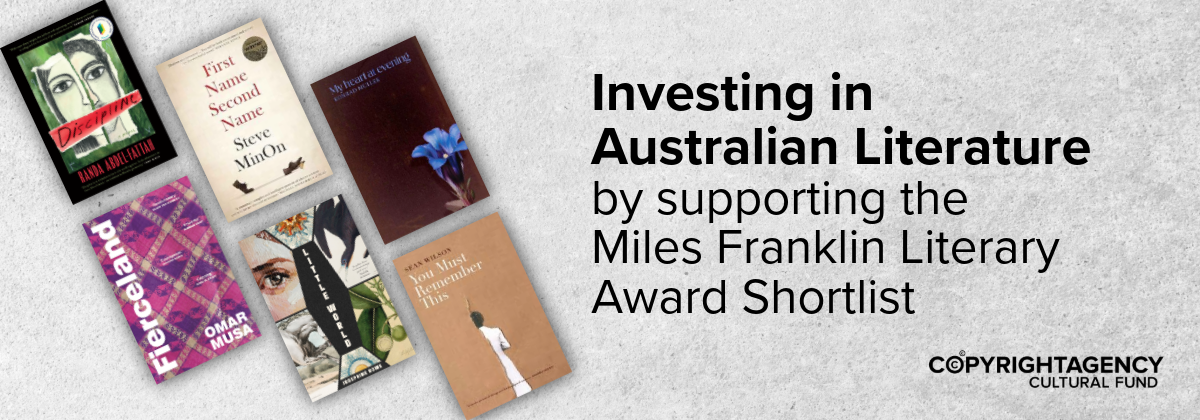
This year, the independent judging panel has shortlisted six novels that portray a diverse portrait of Australian life. Discover the shortlist:
Discipline by Randa Abdel-Fattah (published by University of Queensland Press) is praised by Melissa Lucashenko, ‘Blistering and brilliant’.
The Guardian says ‘With visceral detail, Randa Abdel-Fattah captures the pangs of survivor guilt and rage felt by first-generation Australians witnessing the destruction of their homelands while living in ‘the empire’, and the cost of speaking out against the status quo.’
First Name Second Name by Steve MinOn (published by University of Queensland Press). In his review for The Age, Jason Steger says ‘Takes the reader for an engrossing journey through his family history, with its feedlines from China and Scotland, and along the way considers questions of identity – sexual and racial – with wit and pathos’.
The Australian called it ‘Ambitious and imaginative.’
My Heart at Evening by Konrad Muller (published by Evercreech Editions). Praise from Robert Dessaix, ‘A glossy black cockatoo of a book, as black as midnight, menacingly courtly, with mischievous scarlet flashes. Mephistophelian, brilliant.’
Kate Kruimink writes ‘Above and around the novel’s human complexity are descriptions of nature so vivid that the experience of reading at times becomes more like looking at an oil painting than words on the page.’
Fierceland by Omar Musa (published by Penguin Random House Australia). Ellen Van Neerven says ‘Exhilarating, melodious, smart, resonant about the fragility of our times…A revolutionary novel of consciousness with Borneo at its core. This is the novel I’ve been waiting for.’
Hannah Kent says ‘Potent and powerful, Fierceland is a shapeshifting novel of great reckoning; a brutal, beautiful study of wilderness within and without, of ghosts that afflict and follow in the wake of family, legacy and complicity.’
Little World by Josephine Rowe (published by Black Inc). In her review for The Guardian, Beejay Silcox says ‘There’s no question that Little World is beautiful. Rowe’s fiction has always been uncommonly gorgeous – the kind of gentle, contemplative prose-work that feels akin to prayer.’
In The Conversation, Tony Hughes-d’Aeth praises Rowe’s writing, ‘Little World is a novel for those who find satisfaction in precisely drawn enigmas. The lyricism of the novel is often exquisite.’
You Must Remember This by Sean Wilson (published by Affirm Press). According to The Saturday Paper, ‘Wilson’s writing is lucid and often extremely beautiful in its precision…The real achievement of Wilson’s novel is its desire to give shape to the experience of dementia, and what it must be like to try to hold on to one’s sense of self as it slips away.’
Amanda Lohrey describes the novel as ‘A tender portrait of old age and the slippages of memory.’
Congratulations to all six shortlisted authors on this outstanding achievement. We invite readers to pick up these books and discover the stories, voices and perspectives that make Australian literature so compelling.